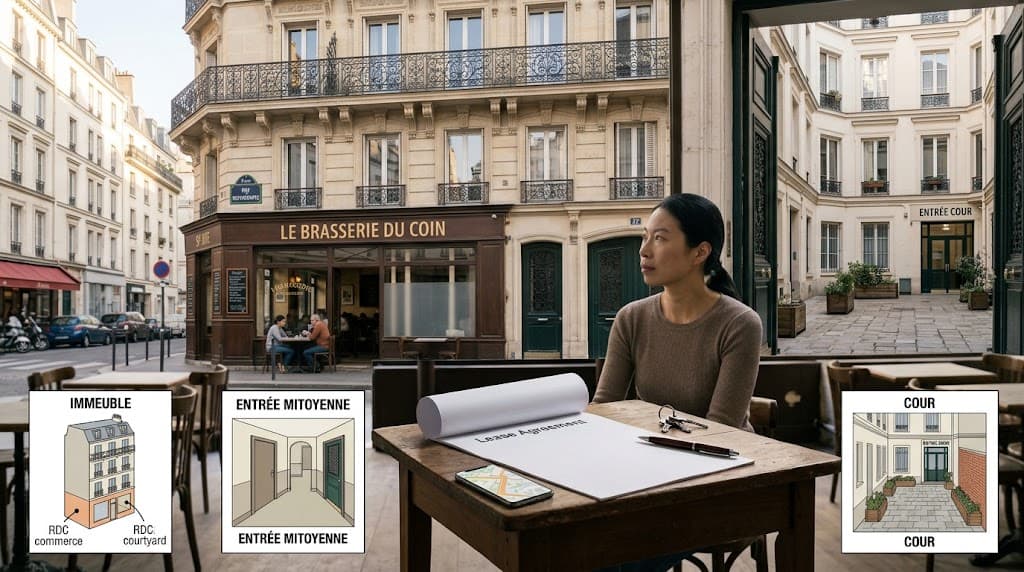
You have the lease. The permitted-use clause allows a restaurant, the landlord agrees, the agent is delighted. And three weeks later the managing agent writes to remind you that the building's co-ownership rules forbid any commercial activity.
He is right, and you have signed.
Why the rules win
An owner cannot pass on more rights than they hold. The landlord is a co-owner: they are themselves bound by the règlement de copropriété. They therefore cannot authorise you to do something those rules forbid them — not in good faith, not in writing, not for rent.
The règlement de copropriété is a contract binding on every occupant of the building, owners and tenants alike. It sits with the syndic, the managing agent, it is annexed to deeds of sale, and it can be asked for.
The clause that forbids everything
Many residential buildings carry a clause d'habitation bourgeoise — a residential-use clause. It comes in two versions, and the gap between them is considerable.
- Bourgeoise stricte: the building is reserved for housing. No professional, commercial or self-employed activity at all. A restaurant is impossible there, full stop.
- Bourgeoise simple: housing and the liberal professions are allowed. Trade is not. A restaurant is equally impossible.
In both cases, a shop on the ground floor proves nothing: it may predate the rules, or have been tolerated for years without anyone acting. Tolerance creates no right, and the day a co-owner decides to act, it is the most recent activity that falls.
Even without a prohibition, the co-ownership decides a great deal
Suppose trade is allowed. The co-ownership still governs everything touching the common parts, and a restaurant touches them more than any other business:
- The extraction flue, which crosses ducts, façade and roof.
- The sign, which is fixed to a common façade.
- The refrigeration unit and the air conditioning, installed in the courtyard or on the roof, which make noise at night.
- The deliveries, whose hours can be restricted.
- The bins, whose store is a common part and is often far too small for a restaurant.
Each of these goes through an authorisation from the general meeting. None of them can be settled in a hurry.
Noise and smells, even when everything is authorised
A perfectly lawful activity can still be condemned for trouble anormal de voisinage — an abnormal neighbourhood nuisance. It is a no-fault liability: you need not have broken anything, it is enough that the disturbance goes beyond what a neighbour should normally put up with.
The three classics for a restaurant in a residential building: the ventilation noise at night, the cooking smells, and customers talking loudly on the terrace at midnight.
What not reading costs
The co-ownership rules can be asked of the managing agent for free and read in an hour. The meeting minutes, likewise.
Against that: a French commercial lease commits you for nine years, with a break every three and compensation if you leave earlier. A forbidden activity can be stopped by a court, and the lease keeps running while that happens.
It is the best ratio of one hour's reading to risk avoided in the whole opening process. And it is the step almost nobody takes.