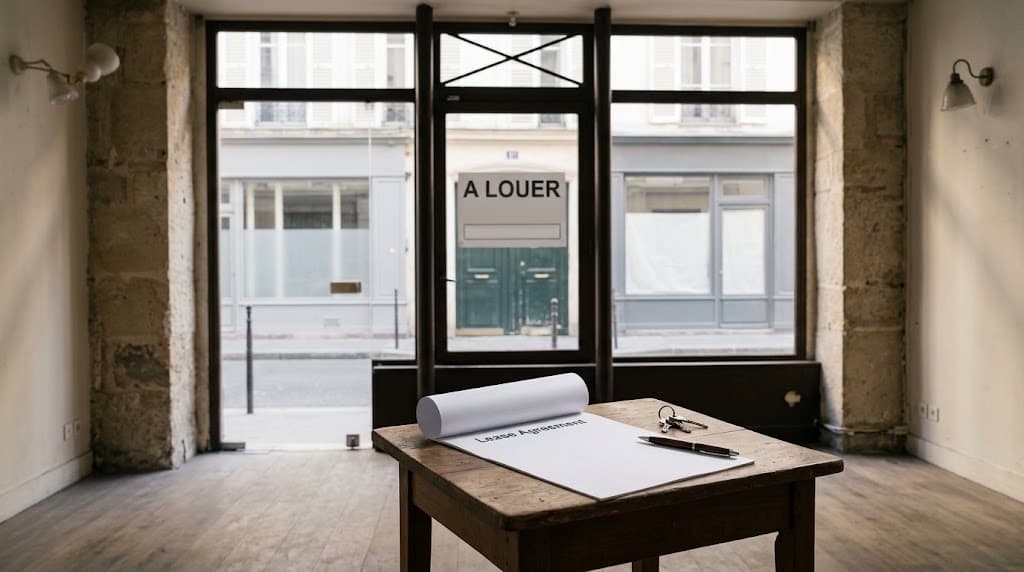
One French word, destination, covers two unrelated things, and that is where most of the nasty surprises come from.
The lease's permitted use is a private matter, between you and the owner of the walls. The planning use is a public matter, between the building and the commune. You can perfectly well hold the contractual right to open a restaurant in premises that planning law does not recognise as one — and the reverse.
The permitted use in the lease
Every French commercial lease contains a clause de destination. It states what the tenant is entitled to carry on in the premises, and it is construed strictly: what is not authorised is forbidden.
Three wordings turn up, and they are not equivalent.
The precise use. « Restaurant traditionnel », « bar à vins », « vente de sandwichs à emporter ». Comfortable if it describes your project — and blocking if your project moves on. Opening in the evening when the lease says « salon de thé » is a change of use.
The « tous commerces » use. The broadest, and the most badly read. It leaves you a great deal of freedom, but you have to read it to the end: many wordings add exclusions — noisy, smelly or unsanitary activities, or ones requiring a licence. A clause reading « tous commerces sauf activités nuisibles au voisinage » does not entitle you to run a rotisserie.
The silent or elderly use. A 1997 lease written for a shoe shop says nothing about a restaurant. It therefore does not authorise one.
Changing the use: déspécialisation
If the lease does not cover your activity, its permitted use has to be changed. The French commercial code calls this déspécialisation, and it knows two kinds.
Partial déspécialisation covers adding activities that are connected or complementary to the one provided for. A restaurant wanting to sell takeaway, typically. The procedure is light: you notify the landlord, who has a period in which to object. If they say nothing, it is granted.
Full déspécialisation covers a different activity. That is the case of an office or a shop you want to turn into a restaurant. Here the procedure is heavy: a reasoned request, a response period for the landlord, the possibility for them to refuse on serious and legitimate grounds, and the possibility for them to claim compensation or a rent review.
The point to remember is not the mechanics, it is the calendar: it takes months, and it can fail. A déspécialisation under way is not a déspécialisation obtained.
Planning law, which is a different person
The French planning code classifies buildings by destinations and sous-destinations. Restaurants are one of them. Moving from one sub-category to another — from retail to restaurant, from office to restaurant — is a change of use, and it has to be authorised.
Depending on the works and the commune, that goes through a déclaration préalable — a prior declaration — or a permis de construire, a building permit. And in some communes the local plan protects neighbourhood shops, or conversely limits restaurants on certain streets.
In what order
- Read the permitted-use clause of the draft lease. Yourself, word for word. Not the agent's summary, not the listing's fact sheet.
- Ask for the landlord's written agreement to your exact activity, annexed to the lease. If they hesitate to put it in writing, you have just learnt something.
- Call planning. Before signing, not during the works.
- Check the co-ownership rules, which override the lease and can forbid what the landlord allows.
That last point always comes as a surprise, and it is the subject of another article: an owner cannot grant you more rights than they hold themselves.