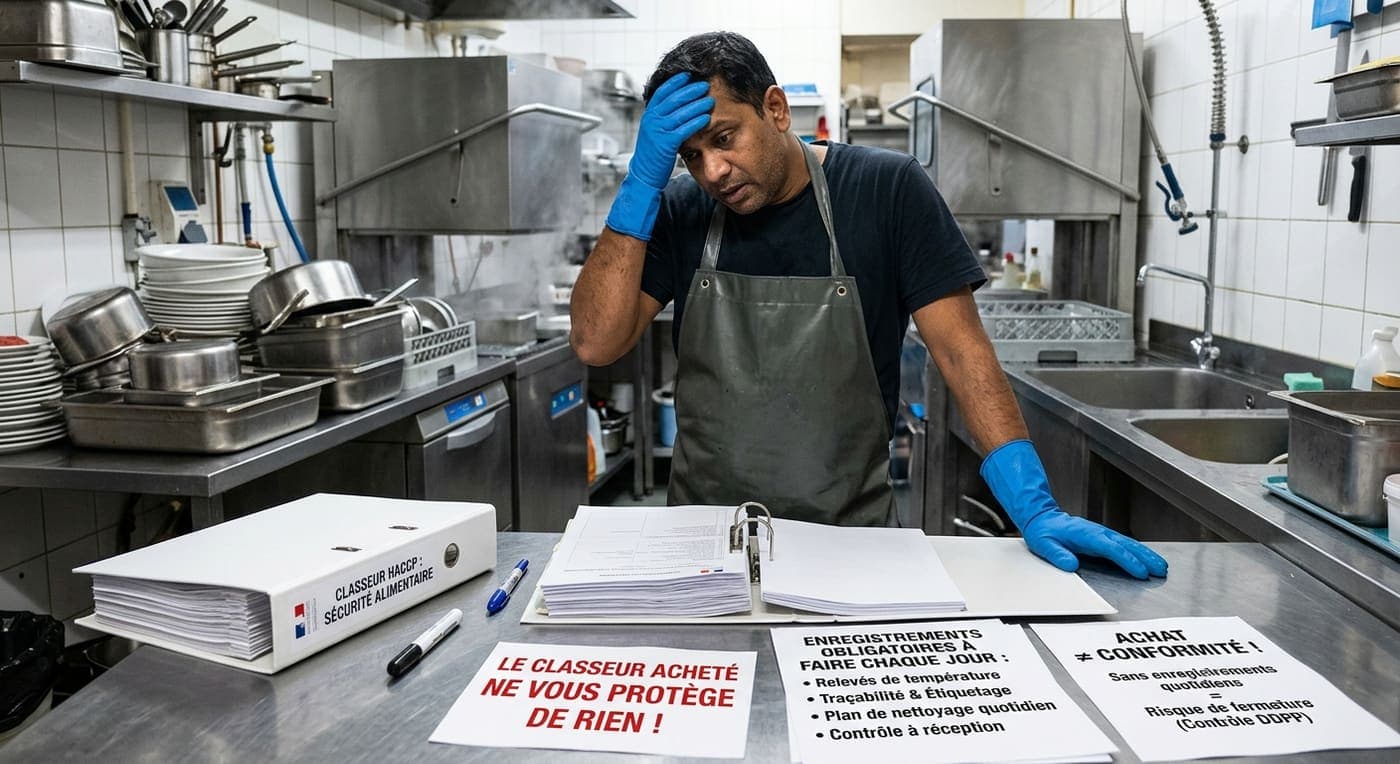
People say "I've got my HACCP" the way they would say they have their driving licence. It is not that, and the confusion is expensive — in money spent for nothing, and in safety you only think you have.
HACCP is not a qualification. It is a hazard analysis method. And behind the acronym there are in fact two separate obligations, with different purposes and different ways of being met.
Two obligations, and only one can be bought
The training. Decree no. 2011-731 requires every commercial catering establishment to have at least one person on its staff who can show food hygiene training — fourteen hours minimum. Two exemptions: a qualification on the list set by order, or three years' experience as a manager or operator in a business in the sector.
That one can be bought, takes two days, and rightly so.
The food safety plan. Article 5 of European regulation no. 852/2004 requires every food business operator to put in place procedures based on HACCP principles. That document is the food safety plan.
That one cannot be bought.
A template is a good starting point — it tells you what to cover. It does not replace the work of adapting it, and that work is done once.
The three parts of the food safety plan
1. Good hygiene practices. This is the foundation, and the longest to write:
- staff: clothing, hand washing, training, monitoring;
- premises and equipment, and the cleaning and disinfection schedule — what, with what, how often, by whom;
- pest control;
- water;
- temperature control;
- separation of flows — clean and dirty that never cross;
- waste.
2. The HACCP plan itself: the seven principles applied to your business. Identify the hazards, determine the points where you can act, set the limits, monitor, correct when things go out of range, verify that the system works, and document all of it.
3. Traceability and handling of non-conformities. One step upstream, one step downstream: knowing where each product came from, and who you passed it to if you did. Plus the withdrawal and recall procedure — who calls whom, in what order, at 10 p.m. on a Saturday.
Temperatures, which are the heart of the inspection
| Situation | Temperature |
|---|---|
| Dishes prepared in advance | +3 °C |
| Highly perishable foods | +4 °C (or the manufacturer's label) |
| Frozen products | −18 °C |
| Hot holding | +63 °C minimum |
| Rapid cooling | from +63 °C to +10 °C in under 2 hours |
Sample meals: what you are not obliged to do
Here is a point on which a great deal gets sold to ordinary restaurants.
- In institutional catering, sample meals are compulsory: samples of 80 to 100 g, kept between 0 and +3 °C for at least five days, available in case of a suspected collective food poisoning.
- In commercial catering, they are not. An ordinary restaurant serving plated food is not required to keep them.
That said, for a group meal or a banquet, keeping them is still a good idea — because if there is a suspicion, it is the only thing that can clear you.
What an inspection really looks at
- Your records. Are they kept as you go, or filled in all at once on the morning of the visit? A temperature log with the same value every day is a confession, not a proof.
- Your traceability. Where what is in the fridge came from, right now, and whether you can show it.
- Consistency between what the document says and what the kitchen does.
- Your team. The question will be put to whoever is there, not to you. If nobody can answer, the binder is worth nothing.
What you have to check yourself
- The good hygiene practice guide for your sector. These guides are validated by the authorities and are the best basis for building your plan.
- The departmental food-safety rules, which can be stricter than the national text.
- Who on your team holds the training — and what happens the day that person leaves.
- What your records say if someone reads them today, without warning.
On the step that comes before all of this, and the case that tips you into approval: Registering your company does not declare your restaurant.