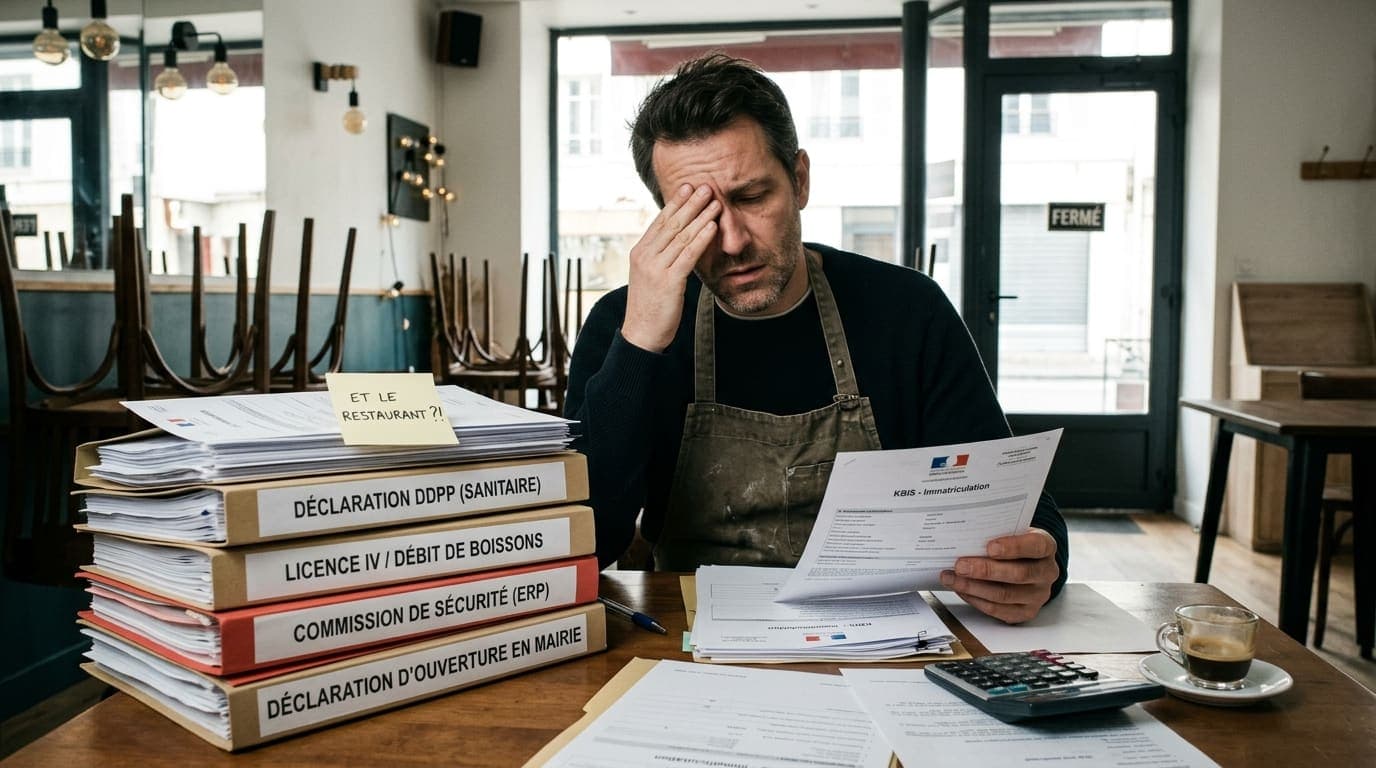
When you set up a company, it feels like everything has been declared. The registry has recorded it, INSEE has issued a SIRET number, the accountant has the file. You assume, reasonably, that the authorities know you are opening a restaurant.
They do not.
Company registration says that a company exists and what its purpose is. It tells nobody that at such an address, from such a date, someone is going to handle meat, fish and dairy. That is a different declaration, to a different authority, and nobody triggers it for you.
The activity declaration
To whom: the departmental directorate for the protection of populations (DDPP) of your department — in some departments the service is called DDETSPP; it is the same contact.
With what: form Cerfa no. 13984, "declaration of handling of foodstuffs of animal origin".
When: before opening. Departmental services generally ask for at least fifteen days; allow a month, you will not regret it.
Who is concerned: any establishment that prepares, treats, processes, handles or stores products of animal origin. A restaurant, obviously. A bar serving charcuterie boards too.
The principle comes from article 6 of European regulation no. 852/2004: every food business establishment must be registered with the competent authority. France applies it through this declaration.
What it is not. It is not an authorisation. Nobody examines your file, nobody visits before saying yes. You declare, you get a receipt back, you are registered.
The case that changes everything: approval
The declaration is enough as long as you sell to the final consumer. That is a restaurant's situation: your customers eat what you prepare.
It is no longer enough as soon as you supply your preparations to another business: you supply terrines to the grocer across the road, you deliver dishes to a bar with no kitchen, you cater for a fellow restaurateur. At that point you need sanitary approval — a real file, examined, with an inspection visit.
Between the two there is a waiver from approval, provided by the order of 8 June 2006, covering small quantities. Two conditions, both of which must be met:
- the quantity supplied stays, per product category, below 30% of your production in that category — unless it stays below the ceiling set in the annex to the order, in which case the 30% limit does not apply;
- the businesses supplied are within a radius of 80 km. The prefect can extend this to 200 km in areas with particular geographical constraints.
What an inspection really looks at
The declaration puts you on the list. What happens next is the inspection — and it is not about the declaration. It is about three things.
The food safety plan. This is the central document, the one you will be asked for first. It describes your good hygiene practices, your approach based on HACCP principles and your traceability system. It is not a binder you buy: it is yours, it describes your kitchen, your flows, your suppliers. An off-the-shelf plan is spotted in three questions.
Training. Since decree no. 2011-731 of 24 June 2011, every commercial catering establishment must have at least one person on its staff who can show food hygiene training — fourteen hours minimum. Two exemptions exist: a qualification on the list set by the order of 25 November 2011, or at least three years' experience as a manager or operator in a food-sector business.
Traceability. Knowing where what is in your fridges came from, and being able to show it. This is where inspections most often go badly — far more than on cleanliness, which you can see coming.
A word on the hygiene rating
Since 2017, the results of official inspections have been published on the Alim'confiance site, in four levels, and anyone can look yours up.
There is some confusion about this, so let us be clear: online publication is automatic; displaying it in your window is not. The DDPP sends you a sticker, and you are free to put it up or not.
Many restaurateurs believe the display is compulsory and worry about it, without having noticed that the result is public online anyway. The opposite is what matters: the rating is visible, sticker or no sticker. Better that it be a good one.
What you have to check yourself
- The departmental food-safety rules can be stricter than the national text.
- The competent service does not have the same name everywhere (DDPP, DDETSPP), and how you file — paper, email, online service — varies from one department to another.
- Your side activities — takeaway, delivery, market stall, cheese cellar, preserves — can shift which regime you fall under. Ask the DDPP before starting, not after.
A phone call to your department's DDPP costs ten minutes. It is the best time-to-peace-of-mind ratio in your whole opening.
This article is part of a series on opening a restaurant: