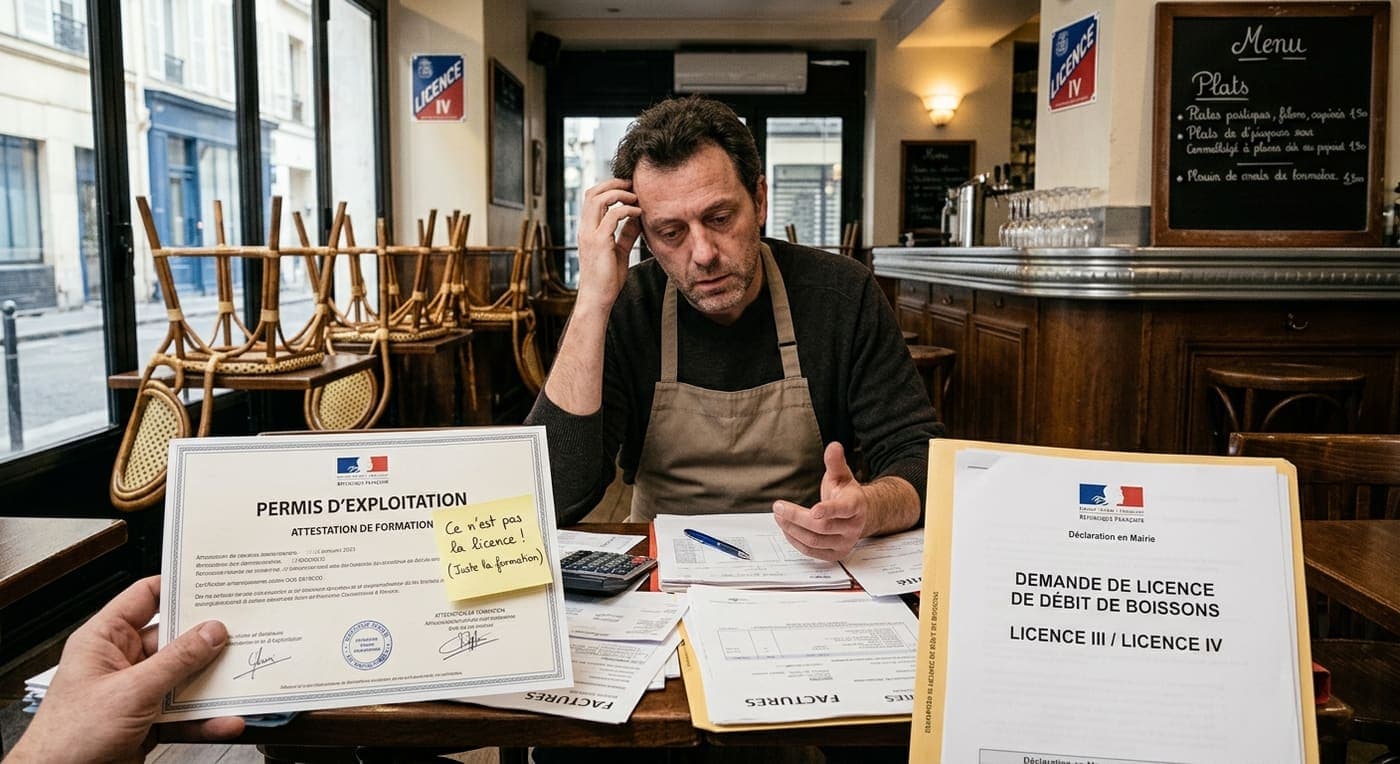
"I've passed my operating permit, so I can serve alcohol."
No. And that sentence, heard almost every time an opening comes up, sums up a confusion that costs either delay or several thousand euros — sometimes both.
The operating permit and the licence are two different things, issued by two different authorities, answering two different questions.
Two documents, two logics
The operating permit is about you. It is a course, taken with an approved provider, certifying your knowledge of the rules: protection of minors, public drunkenness, noise control, opening hours. It follows you; it does not belong to the premises.
The licence is about the premises. It is a right, attached to a business and an address, saying which drinks may be served there and under what conditions.
You need both. And above all: having the first does not give you the second.
The question that costs the most: which licence
Drinks are sorted into groups. Since 2016 there have been four — the old group 2 disappeared, folded into group 3:
- group 1: non-alcoholic drinks;
- group 3: wine, beer, cider, and more generally undistilled fermented drinks up to 18°;
- groups 4 and 5: spirits, that is, anything distilled.
From there, two families of licence — and this is where the confusion gets expensive.
For a restaurant, meaning a place where people drink while eating:
- the small restaurant licence covers group 3 — wine, beer, cider — during meals;
- the restaurant licence covers everything, spirits included, during meals.
For a drinks outlet, meaning a place where people drink without eating:
- licence III covers up to 18°;
- licence IV covers everything.
So ask the question this way round, not the other: do I want to serve a drink to someone who is not eating? If the answer is no, the matter is closed and you have just saved the price of a licence IV.
Why a licence IV has to be bought
Because no new ones are created. The stock has been closed for a long time: a licence IV is obtained by buying it from a business that is closing, at a market price that varies enormously by region.
It can be transferred, but not in any way you like — the transfer happens within the same department, under conditions, with prefectural authorisation. And it expires.
A waiver allowed a licence IV to be created, between late 2019 and late 2022, in towns of fewer than 3,500 inhabitants that no longer had one. It has expired. A bill to reopen that possibility in rural areas passed its first reading in the National Assembly in March 2025; if this is your case, it is a question for your town hall rather than for an article.
The declaration, and the timetable that pushes openings back
The prior declaration is filed at least fifteen days before trading begins, using form Cerfa no. 11542. It also applies to a transfer — you are taking over an existing business — or a relocation.
Where: at the town hall. In Paris, at the police prefecture; in Alsace-Moselle, at the prefecture.
What you are asked for: identification and your operating permit, still valid.
What you get back: a receipt, which is your proof of licence. Keep it.
That is why this step belongs on the list of things to start early, even though it only concerns the very end of the project: it is not expensive, it requires no building work, and it is perfectly capable of delaying an opening.
What comes with it, and gets found out afterwards
- Takeaway sales between 10 p.m. and 8 a.m. fall under another permit: the permit for night-time sale of alcoholic drinks, a one-day course (seven hours), also valid ten years. It does not replace the operating permit, and the operating permit does not replace it.
- Protected zones. A prefectural order sets perimeters around schools, hospitals and barracks in which a drinks outlet cannot open. Premises can be perfect and ineligible; check this before signing the lease.
- Closing hours are set by prefectural order, and waivers have to be requested.
- Notices on the protection of minors and on public drunkenness are compulsory in the dining room.
What you have to check yourself
- The protected zone at the exact address of the premises, at the town hall or the prefecture. It is the only question that can kill a project, and it is the one that comes up earliest.
- The hours applying in your town, and the waiver procedure if you are aiming for late service.
- If you are taking over an existing business: the licence follows the business, but the transfer must be declared, and the seller's operating permit does not transfer. You have to hold one, in your own name.
This article is part of a series on opening a restaurant: