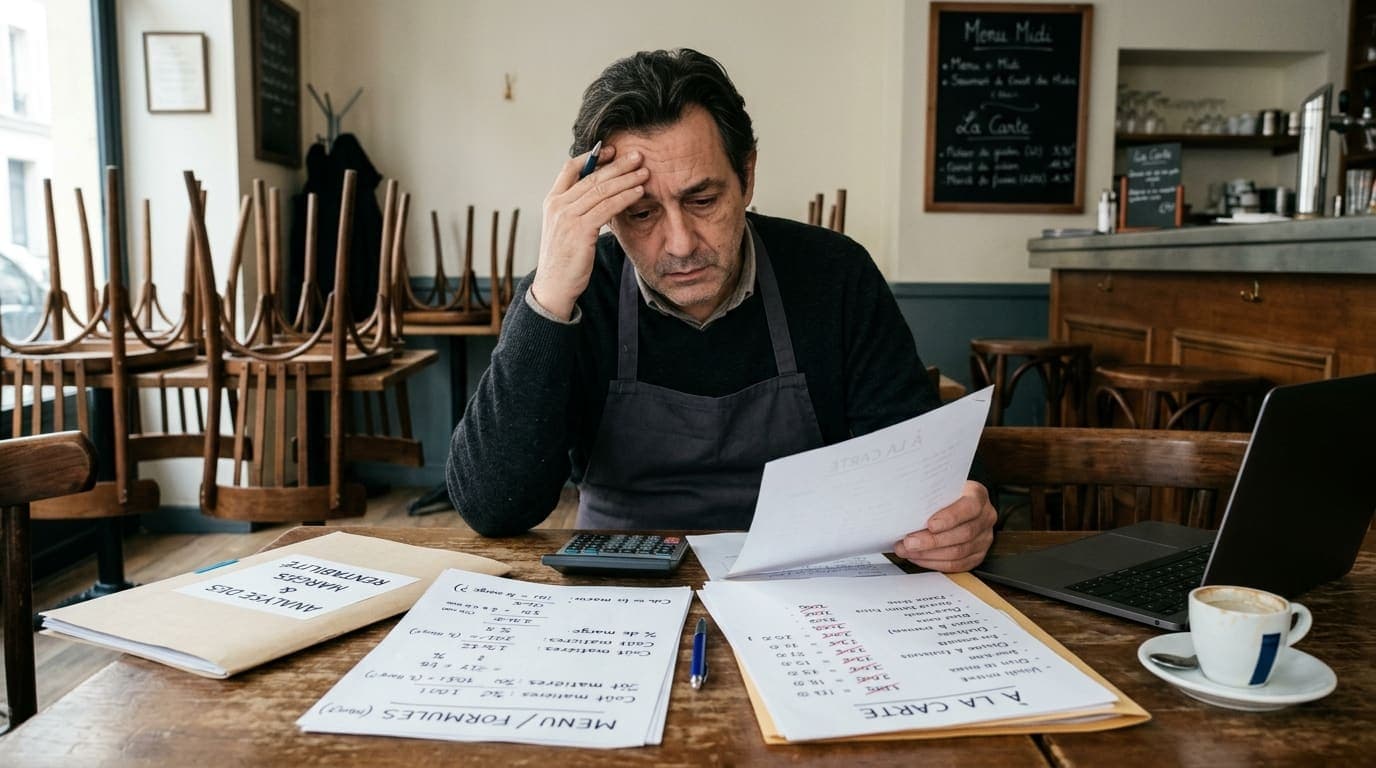
“We'll do à la carte, so people can choose.”
It is the single most consequential decision of the whole opening, and it is often made in one sentence, one evening, in the belief that it is a question of presentation.
It is not. Choosing between a set menu and à la carte does not decide what the customer reads: it decides how many items your kitchen has to hold at the same time. And that number governs your stock, your waste, your morning prep, and what you have to teach every new commis.
The five formats, and what they do to your kitchen
The all-in set menu. One price, a complete meal, a restricted choice — two starters, two mains, two desserts. The customer knows what they will pay before coming in, which remains the most powerful argument there is. Your kitchen holds six items. Your ordering is simple, your waste low. Against that: a tighter margin, because that advertised price has to stay competitive, and a choice narrow enough to lose a table of four when one of them does not eat fish.
The modular set menu. One price per course: starters at this price, fish at that one. The customer keeps the safety of a known price and gains choice. You multiply the items within each band — and that is where it goes wrong, because six starters at the same price do not have the same food cost.
The “main course” menu. The main sets the price of the meal; starter and dessert follow. Excellent when you have a strong-identity product people come for. The drawback is psychological: the customer feels they are paying a lot for one dish, because they cannot see what the starter and dessert cost.
The daily special. The weapon of houses with a daily clientele. It avoids monotony, it absorbs the market, it clears stock. In return it demands that you know your regulars' tastes very well, otherwise it produces unsold food instead of preventing it.
À la carte alone. Maximum choice, often a better unit margin — and the maximum number of items to hold. It is the most expensive format in organisational terms, and the least forgiving of a forecasting error.
In practice almost every house that lasts does a mixture: a short permanent base, plus a board that moves. The base amortises the equipment and the training; the board brings the regulars back and absorbs the market.
The figure people optimise, and the one they should
Ask a restaurateur the food cost of their signature dish and they will give you a percentage. It is the reflex of the trade, and it is the wrong figure.
Take two dishes, at 10% VAT:
| Price incl. VAT | Price excl. VAT | Food cost | Ratio | Margin | |
|---|---|---|---|---|---|
| Dish A | €14.00 | €12.73 | €3.80 | 29.9% | €8.93 |
| Dish B | €26.00 | €23.64 | €8.30 | 35.1% | €15.34 |
Dish B has the “bad” ratio. It earns €6.41 more on every plate.
The four families of dishes
The method dates from 1982 — Michael Kasavana and Donald Smith, at Michigan State's hotel school — and it has not aged a day, because it asks each dish only two questions: does it earn? and does it sell?
Four cases, and four different actions:
- Stars — high margin, high sales. Touch nothing. Not the recipe, not the portion, not the supplier. Give them the best spot on the menu and talk about them in the dining room.
- Plough horses — low margin, high sales. People come for these: do not remove them. Work on the cost, the portion, the garnish, or raise the price in small steps. This is the dish that fills the room, not the one that makes it pay.
- Puzzles — high margin, low sales. The dish is good and it earns, but nobody orders it. It is almost always a problem of description, of position on the menu, or of suggestion by the staff. Before taking it off, try moving it and having it announced.
- Dogs — low margin, low sales. Take them off. It is the most profitable decision on the list and the hardest: there is always someone, in the kitchen or the dining room, who will defend the dish that does not sell.
What the law puts on your menu
A menu is not only a commercial document. Several statements on it are compulsory, and they are the ones people discover at the first inspection:
- Display outside. The prices of the most commonly served items must be legible from the street, and the list of set menus or the dish of the day displayed throughout service — from 11.30 am at the latest for lunch and 6 pm for dinner.
- Five wines. The menu must give the price of five wines — or five commonly served drinks if you serve none — with the quantity served. It is the requirement almost nobody knows about.
- Prices include VAT, and the display must state whether service is included.
- Allergens. The fourteen notifiable allergens must be brought to the customer's attention: on the menu beside each dish, in a document kept available, or on a board displayed in the room. Your choice, but not nowhere.
- Meat origin. Since March 2022, beef, pork, lamb and poultry bought raw require the country of rearing and the country of slaughter to be stated, legibly and visibly — on the menu or on another medium.
- “Fait maison” (made on the premises) is a regulated statement with a precise definition. It does not go on at random, and a menu that uses it wrongly is a menu that lies to its customer.
A formatting detail that can be measured
A study from Cornell's hotel school in 2009 compared three ways of writing prices on the same menu: with the currency symbol, in figures alone, and spelled out in words. The customers given the menu in figures alone spent on average 8.15% more than the other two groups.
Take it for what it is worth: one restaurant, one service, in the United States, more than fifteen years ago. But the direction is right, and it matches what the dining room teaches: anything that makes a price look like a price encourages people to read the menu as a price list.
The practical corollary is more useful than the study: avoid the right-aligned price column with the little dotted leaders. It invites people to run down the column of prices instead of reading the dishes — and the customer then chooses the cheapest, not the one they want.
What to check yourself
- Your figures, not an article's. Everything above is a method; the averages that matter are yours, and they come out of your till.
- Real food cost, waste included. The recipe card says what the perfect plate costs. Your margin also pays for trimmings, mistakes and what goes in the bin on Sunday night.
- The exact conditions for “fait maison” before you put it on.
- The local bylaw for outside display and the terrace, which can add its own constraints.
If you have not opened yet, the running order is elsewhere: Opening a restaurant in France: what nobody tells you in time.