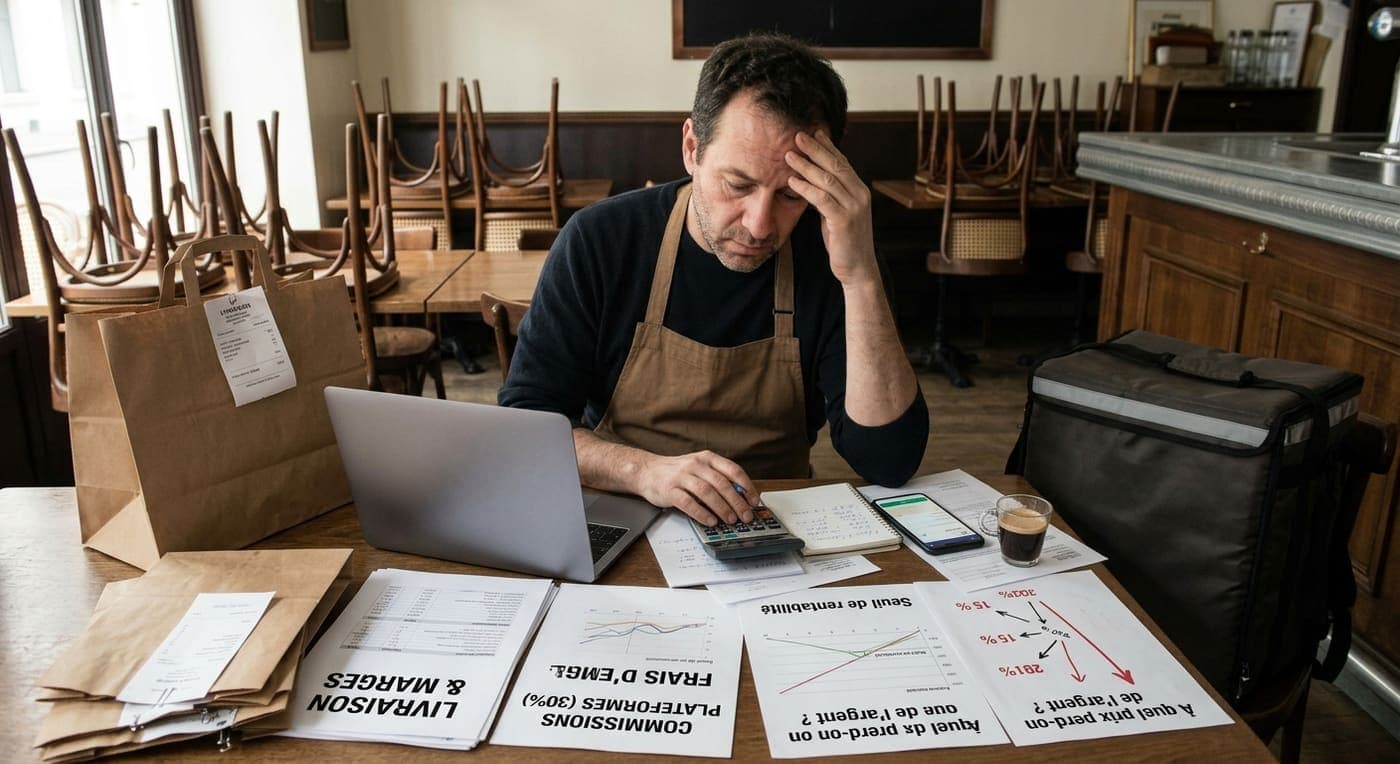
Let us say it up front: we are not neutral. Klarr sells a booking and ordering page with no commission. So we have a direct interest in you finding platform commissions too expensive.
Read what follows with that in mind — and above all, redo the sums with your own figures. That is the whole point of the article: you do not need to believe us, you need a method.
What cannot be told to you, and why
You have read “30% commission” somewhere. So have we. We went looking for the source, and there is no solid one.
The rates quoted run from about 14% to 30% depending on the arrangement — delivery by the platform, delivery by you, collection only — and vary with the contract, the city, how long you have been on it, and what you negotiated. No platform publishes a schedule you could rely on, and no public French report fixes the figure.
So let us handle it differently. The only rate that counts is yours, and it is on your statements. This article gives what can be given: the list of what makes up the real cost, and the calculation to do next.
The six lines that make up the real cost
What you pay is never the headline commission alone:
- The commission, according to the arrangement chosen.
- Service and payment fees, added on top of the commission.
- Shared promotions — the “buy one get one free” you part-fund.
- Advertising on the platform. Ranking is paid for; not paying means going down.
- Uncontested disputes. An order refunded to the customer stays at your expense if you do not contest it within the deadline. That deadline is short, and nobody is watching it on a Saturday night.
- Packaging.
The calculation, on one dish
Take a dish sold at €18 in the dining room, VAT at 10%, food cost €5.00.
| Dining room | Delivery | |
|---|---|---|
| Price shown | €18.00 | €18.00 |
| Price excl. VAT | €16.36 | €16.36 |
| Commission (30% of net) | — | − €4.91 |
| Food cost | − €5.00 | − €5.00 |
| Packaging | — | − €0.80 |
| You are left with | €11.36 | €5.65 |
So what price would it have to be? We are looking for the price that leaves the same €11.36:
(Target margin + food cost + packaging) ÷ (1 − rate), then add VAT.
(11.36 + 5.00 + 0.80) ÷ 0.70 = €24.51 net, that is €27 including VAT.
That is +50% on the dining-room price.
And there is the real question, which no indignant article asks: will anyone order your dish at €27 when the one next door is €18? No. So in practice you do not recover your margin. You make trade-offs.
Why your dishes do not all survive it alike
This is the point almost nobody explains, and it is the most useful.
The commission is proportional to the price. The food cost is not. Two dishes sold at the same price, with different food costs, come out of delivery in very different states:
| €18 dish | Food cost | Dining-room margin | Left on delivery | What survives |
|---|---|---|---|---|
| Low food cost | €3.00 | €13.36 | €7.65 | 57% |
| High food cost | €7.00 | €9.36 | €3.65 | 39% |
The low-food-cost dish keeps more than half its margin. The high-food-cost one loses nearly two thirds.
That is why pasta, pizza and bowls hold up in delivery and a good piece of fish does not. It is not a question of transport or of taste: it is arithmetic.
Consequence: a delivery menu is not your menu. It is a subset, chosen for exactly that reason — and it is exactly what the houses that make money on delivery do.
The accounting trap nobody mentions
Three things to know, and the third is expensive:
- What the customer pays for delivery is not your turnover. Do not count it in.
- The commission is a service at 20% VAT, deductible like any other cost.
- And depending on the entity that invoices you, VAT on that commission is reverse-charged. When the invoice comes from a company established in another EU country, it is not charging you French VAT: you declare it and deduct it, on your own return. When the invoice comes from a French entity, VAT appears on it and is simply deducted.
Forgetting the reverse charge does not show up straight away. It shows up at the audit, and it is settled with interest.
What decides is the entity issuing your invoice, not the name of the app. Pull out a commission invoice, look at who signs it and from which country, and put the question to your accountant. Ten minutes.
What the platforms actually bring
An honest article has to say this too, otherwise it is only a sales pitch:
- Volume in quiet hours. A kitchen switched on at 3 pm with a cook on the payroll produces zero euros. A dish with €5.65 of margin is not a good deal, but it beats nothing.
- Discovery. People who did not know your name try you. Some will come back to the dining room.
- No acquisition cost and no logistics. You pay for no advertising, no rider, no insurance. You pay a percentage on what goes through, and nothing when nothing does.
- Regular cash flow, which is not nothing when the dining room is irregular.
So the right question is not “platform or no platform”. It is: which dishes, at which hours, at what price.
What you do not gain from it
- The customer is not yours. You know neither their name, nor their address, nor their history. You cannot bring them back without going through the platform again — and paying again.
- Ranking is paid for. Visibility is not acquired: it is bought, in advertising and in promotions you fund.
What to check yourself
- Your real rate, from your statements over the last three months — not an article's, ours included.
- The basis of calculation: is the commission charged on the net or the gross price? The contract says, and it changes the result.
- The deadline for contesting disputes, and who watches it in your house.
- The reverse charge, with your accountant, invoice in hand.
- The parity clauses in your current contract.
On building a menu and the figure actually worth looking at: Set menu or à la carte: what your choice does to your margins.