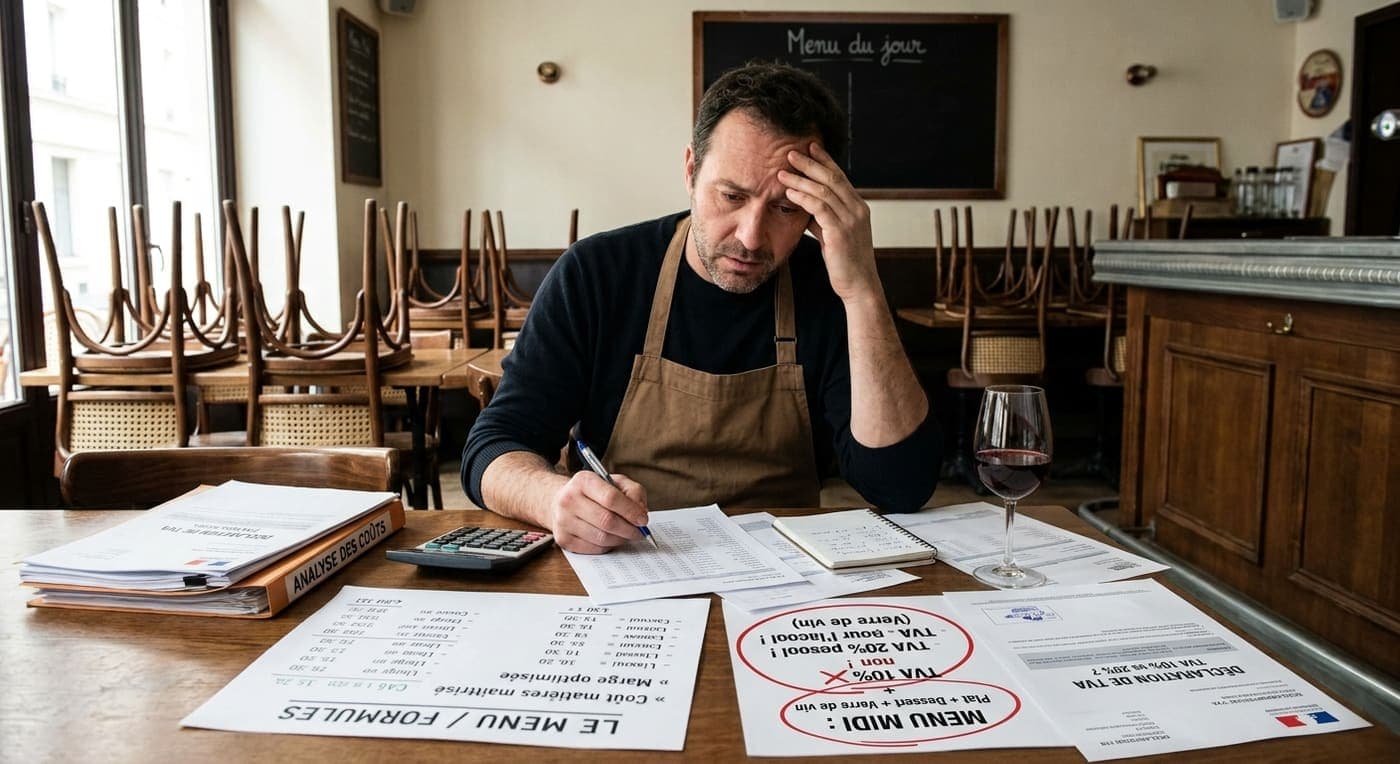
“Restaurants are 10%.”
True for food. Not true for alcohol, and the difficulty begins exactly where the two meet: in a fixed-price menu that includes a glass of wine.
The three rates, in the order you meet them
- 10% — sales for consumption on the premises: food and non-alcoholic drinks. And, since 2012, takeaway or delivery of food prepared for immediate consumption.
- 20% — all alcoholic drinks, no exception and no distinction: on the premises, takeaway, delivered. A glass of wine at the bar and a bottle sold to take away fall under the same rate.
- 5.5% — food intended for deferred consumption, that is, packaged in containers allowing it to be kept. Bread, a terrine in a jar, a vacuum-packed dish to reheat at home.
So the dividing line between 10% and 5.5% is not “eat in or take away”: it is immediate or deferred.
The trap: the fixed-price menu
You sell a €32 menu with a starter, a main, a dessert and a glass of wine. The customer pays a single price. But that price covers two operations taxed differently.
So it has to be split. And the burden of that split is yours: the authorities expect an economically rational method that you are able to justify.
The method, on a €32 menu
The tax administration's own guidance gives an acceptable method where the items in the menu are also sold à la carte: you work out the share of the à la carte price that falls under the reduced rate, and apply that ratio to the menu price.
Take this carte:
| Item | Price incl. VAT à la carte | Rate | Price excl. VAT |
|---|---|---|---|
| Starter | €9.00 | 10% | €8.18 |
| Main | €22.00 | 10% | €20.00 |
| Dessert | €8.00 | 10% | €7.27 |
| Glass of wine | €6.00 | 20% | €5.00 |
| Total à la carte | €40.45 |
The reduced-rate share is €35.45 out of €40.45, that is 87.64%. The 20% share is therefore 12.36%.
Apply those proportions to the menu:
Menu price incl. VAT: €32.00
Base at 10%: €25.21 → VAT €2.52 Base at 20%: €3.56 → VAT €0.71
Total VAT: €3.23
Two points on the method:
- The split is assessed menu by menu. A single flat method for all menus containing alcohol is accepted, provided the proportion of alcohol is similar from one to the next.
- If your items are not sold separately à la carte, the method above does not apply as it stands. You have to build another one — and be able to explain it.
The other places it comes up
- Coffee. A non-alcoholic drink: 10% on the premises, and 10% takeaway since it is for immediate consumption.
- A bottle sold to take away. 20%, as by the glass. Alcohol knows no reduced rate.
- Bread, jars, vacuum-packed dishes sold for later: 5.5%, because consumption is deferred.
- The same hot dish to take away: 10%, because it is not.
- Lunch deals with a drink: the same trap as the evening menu, only more often.
The link with no-shows that nobody makes
Here is a point worth a meeting with your accountant, and it follows directly from what you write in your terms.
- Arrhes kept after a customer backs out are in the nature of flat-rate compensation for withdrawal: they make good a loss, they pay for no service. As such they are outside the scope of VAT.
- An acompte is a first payment against the price of a future operation. It is within the scope, and VAT becomes chargeable as soon as it is received.
→ No-shows: what they cost, and what actually reduces them
What to check yourself
- Your current splitting method. Does it exist? Can anyone explain it? If the answer is no twice, that is this week's job.
- Your deals and set menus that include an alcoholic drink, lunch offers and group deals included.
- How your cancellation terms are drafted: arrhes or acompte.
- And above all, your accountant. This article gives the framework and the order of magnitude; it does not replace someone with your invoices in front of them. That is an hour's appointment against several thousand euros of possible reassessment.