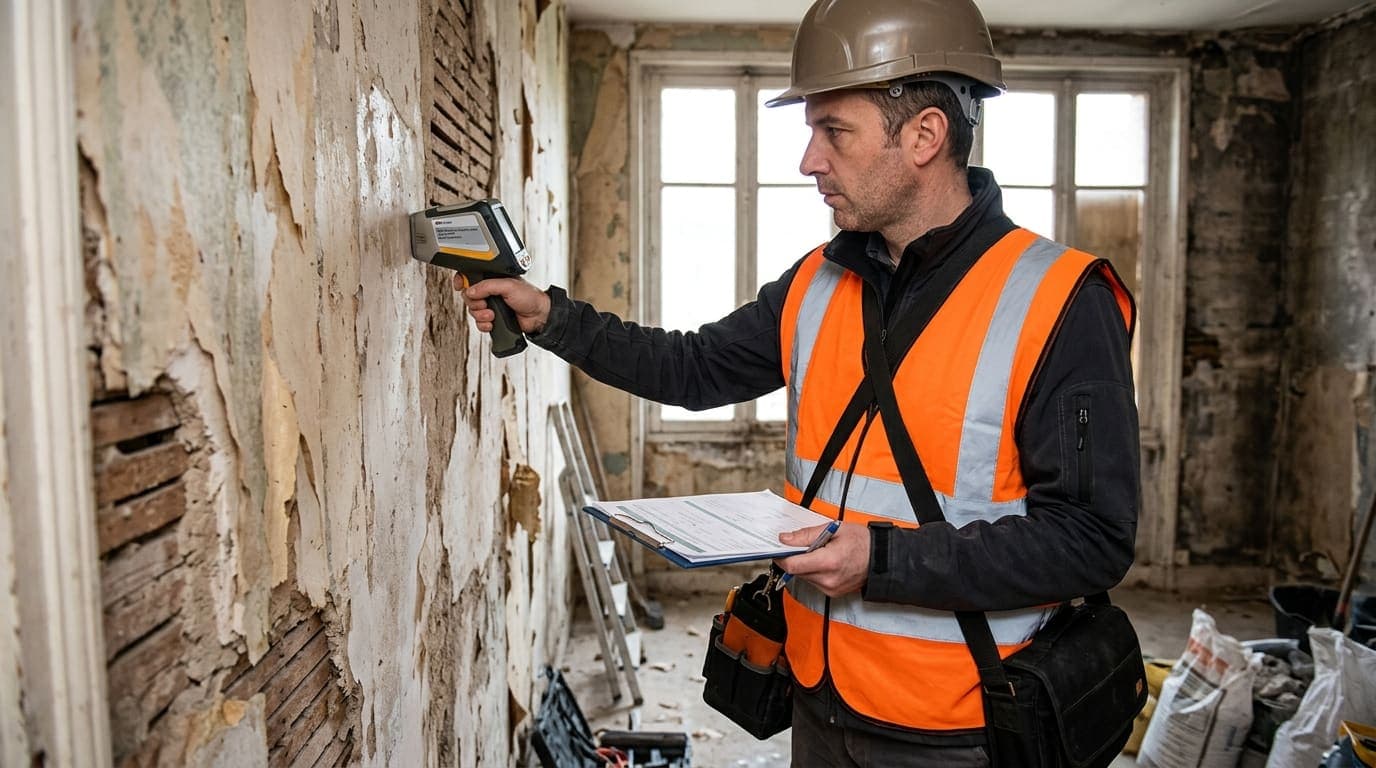
Here is the mistake almost everyone makes, and I made it: the property survey handed over at the sale or at the signing of the lease is not a pre-works survey. They are two different documents, with two different purposes, and the second is yours to pay for.
The first informs the buyer or tenant about the state of the property. The second protects the workers who are going to drill, sand and strip out. The first looks at what is visible; the second goes looking for what is behind the partitions, under the coverings, in the tile adhesive.
By the time you notice, the work has started. That is too late: it has to be stopped.
The pre-works asbestos survey
Who has to do it: you, as the client — that is, the person who decides on the work. Not the contractor, not the owner of the building. You.
When: before the work begins, and the report must be given to the companies carrying it out, so they can organise their protection.
The obligation comes from decree no. 2017-899, codified in articles R. 4412-97 and following of the labour code. The survey must be carried out by a certified operator.
What it changes in practice. A restaurant means work that touches everything: removing suspended ceilings, drilling for extraction, chasing for plumbing, taking up old floors. All places where asbestos used to hide — floor tiles, adhesives, sprayed coatings, ducts.
If the survey finds asbestos, the work is not impossible: it becomes regulated, with certified companies and longer timescales. What costs money is not the asbestos, it is discovering it mid-project.
Lead
Same logic, different material. For buildings constructed before 1 January 1949, the lead exposure risk report covers old paintwork. Here too, the report handed over at the sale does not cover the same thing as a survey meant to protect workers who are going to scrape and sand.
If you are taking over premises in an old building — and in Paris, Lyon or Bordeaux that is the rule rather than the exception — ask the question before signing the quote for the work, not after.
The noise impact study
That one surprises everybody, because people think it only concerns nightclubs.
It does not talk about discotheques, it talks about amplified sound. Decree no. 2017-1244 of 7 August 2017 covers venues open to the public — enclosed or open — that play it regularly and at a high level. A music bar, a restaurant that programmes a DJ on Fridays, a rooftop with a sound system: concerned. A restaurant playing background music during service, at a volume that lets tables talk to each other: not. Both conditions count, and the second is measured with a sound level meter rather than by ear.
What it contains: a study by an acoustician, examining the effect of the different configurations of your installation on the neighbours, and determining the measures to take — sound pressure limiter, insulation, speaker orientation.
The timing trap. The study exists to decide on the soundproofing work. Doing it after the work means discovering that a ceiling you have just put up has to come down. So it belongs in the design phase, with the architect, not at the end.
You will be asked for it at opening, but also when applying for late hours, during an inspection, or at the first complaint from a neighbour. Better to have it.
In what order
- Before signing the lease — ask for the existing surveys and the year of construction. They will not be enough, but they tell you what is coming.
- Before drawing up the work — noise impact study if you intend to play music. It conditions the plan.
- Before the first hammer blow — asbestos survey, and lead if the building predates 1949. Report passed on to the contractors.
- During the work — see the article on your obligations when workers are on your site: they are not what you think.
What you have to check yourself
This article gives the national framework. Three things are beyond it and are settled locally:
- your public-access building category, which depends on the occupancy you admit and changes the safety obligations;
- the departmental health rules, which can be stricter than the national text on noise;
- the local planning scheme, for everything to do with the façade, the sign and the extraction.
Those three are asked of your town hall and the prefecture, and nobody else can answer for you.