
Let's say it upfront: we are not neutral. Klarr has just added DeepSeek and Doubao to the assistants it asks about restaurants, so we have an interest in you caring. This article explains why the issue exists, what works, and how to check it without us.
The guest ChatGPT doesn't see
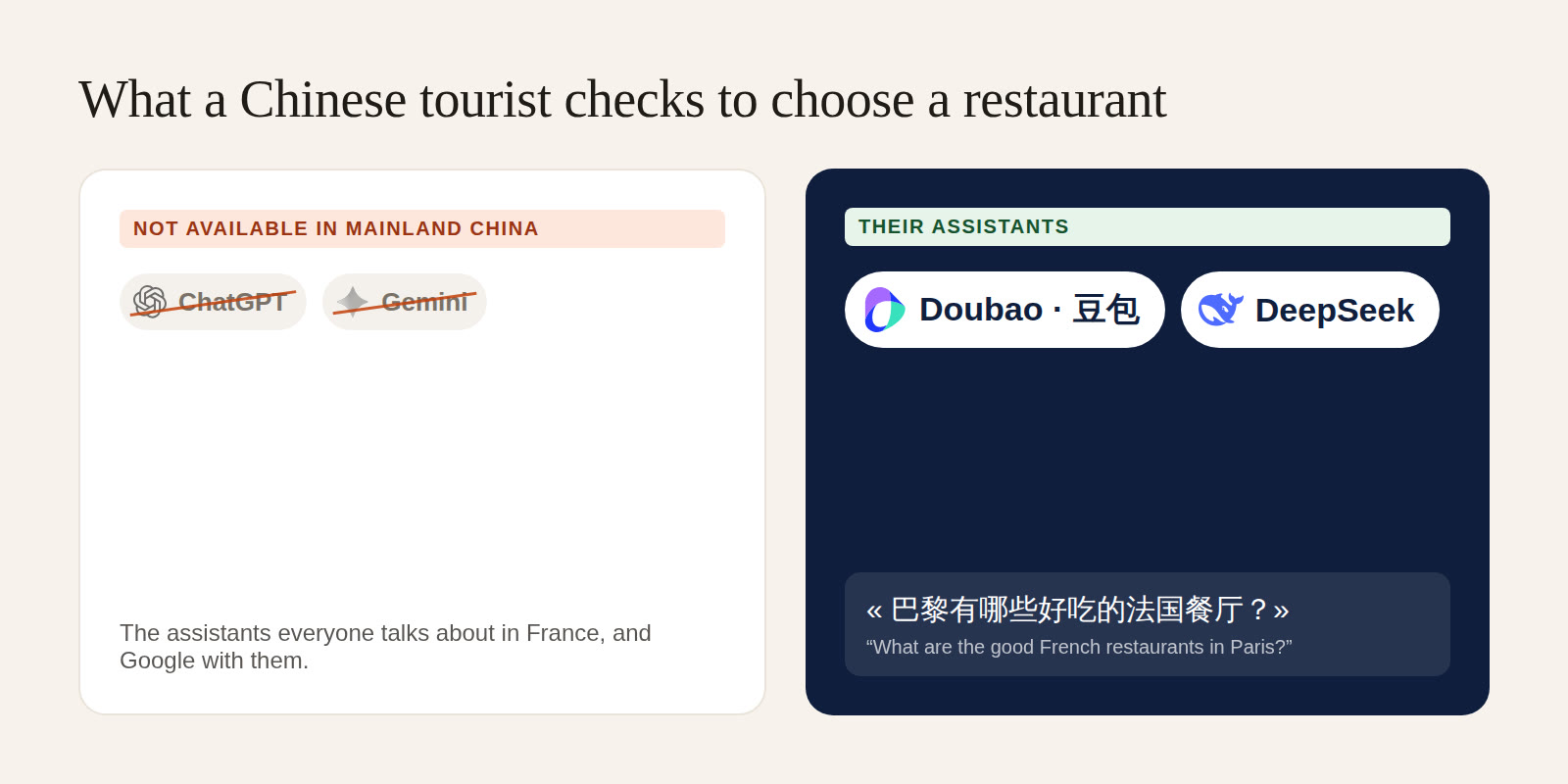
When people talk about AI and restaurants, they mean ChatGPT, Gemini, sometimes Perplexity. For an American or German tourist, that's right. For a Chinese tourist, it misses the point: ChatGPT isn't offered in mainland China, and Google's services are blocked there. They don't search "best bistro Paris" on Google Maps, and they don't ask ChatGPT.
This guest isn't a niche. Chinese visitors have been coming back to France since travel restrictions ended, younger and more independent than before: fewer coach tours, more couples and friends planning their own trip, phone in hand. And they remain among the visitors who spend the most.
The assistants they use
In China, by far the most used assistant is Doubao (豆包), built by ByteDance, TikTok's parent company. According to QuestMobile figures published in summer 2026, it has several hundred million users every month, more than the next two combined: Alibaba's Qwen, and DeepSeek, known in the West since early 2025.
So to plan a trip, this tourist asks Doubao or DeepSeek, in Chinese: "巴黎有哪些好吃的法国餐厅?" ("What are the good French restaurants in Paris?"). The assistant answers like ours do: two or three names, and that's it.
What they know about you
Like ChatGPT, these assistants don't know your restaurant. They know what their sources say about you. The difference is that their sources aren't ours.
Where a Western assistant reads your Google listing, TripAdvisor and local press, a Chinese assistant leans heavily on the Chinese web:
- Xiaohongshu (小红书), the network where travellers post diaries, photos and addresses;
- Dianping (大众点评), China's TripAdvisor, which also lists restaurants abroad;
- Trip.com (携程) and travel platforms;
- blogs and travel diaries in Chinese.
A restaurant nobody has mentioned on these sites is, for Doubao, a restaurant that doesn't exist. It hasn't forgotten you: it has never come across you.
What actually works
Nothing magic, and nothing new: it's the work you do for Google, moved to other places.
1. The same information everywhere. Your name, address and opening hours must be identical on every site where you appear. If your restaurant has a Chinese name, or a transcription your guests use, always use the same one.
2. A page a machine can read. A clear page on your own website, with your cuisine, your neighbourhood and your dishes, that assistants can pick up. A Chinese version, even a short one, helps a Chinese reader as much as a Chinese assistant.
3. Check your presence where they look. Search for your restaurant on Dianping and Trip.com. If it shows a wrong address or another place's photo, that's what the assistants will read.
4. Guests who talk about you. One happy Chinese guest posting on Xiaohongshu does more for you than any text you write. A menu they can read, a payment method they know, a good photo of your signature dish: that's what they'll share.
5. Nothing fabricated. Fake reviews and fake travel diaries exist on these platforms too, with the same risks as here: removal, penalties, and a reputation that doesn't recover.
Check it yourself
DeepSeek can be used from France, on its website or app. Doubao is mostly available in China: a relative or a Chinese guest can run the test for you. Ask in Chinese, like a tourist would: "巴黎二区有什么好吃的餐厅?" ("Where to eat well in Paris's 2nd arrondissement?"). Write down the date, the answer and the names given. Ask again a month later, after your fixes.
Klarr does it for you every month, with your questions, alongside ChatGPT, Claude, Gemini, Perplexity and Le Chat, and keeps every answer with its date. One honest caveat: ChatGPT, Gemini and Perplexity search the web as they do in their apps; DeepSeek, Doubao and the others answer from their own knowledge, without live search. What Klarr measures is what the assistants say about you, and how that changes over time.