This article concerns restaurants in France. The titre-restaurant is a meal voucher many French employers give their staff. The sources, at the bottom of the page, are in French.
Where the text stands
The bill "to modernise and rebalance the functioning of the titre-restaurant" was tabled on 9 June 2026 by MP Christophe Naegelen (LIOT group, Vosges). It has four articles.
| Date | Stage |
|---|---|
| 9 June 2026 | Bill no. 2892 tabled |
| 28 September 2026 | The government triggers the accelerated procedure |
| 7 October 2026 | Examined and adopted by the Social Affairs Committee |
| 12 October 2026 | Debated in public session at the National Assembly |
| Then | Examined by the Senate, then search for an agreement between the two chambers |
The accelerated procedure means a single reading in each chamber before a joint committee, instead of the usual back and forth. The timetable is tight for a simple reason: the current permission to pay for all food shopping with meal vouchers ends on 31 December 2026.
What the text provides
As tabled, the text provides for:
- use for all food products, permanently, including those not ready to eat (pasta, flour, raw meat…), with exceptions set by decree. That is what currently allows people to do their supermarket shopping with their vouchers;
- the end of paper vouchers on 1 January 2028: the meal voucher would become fully digital (card or app), with 2027 as a transition year;
- an annual statement of fees: each issuer would have to send the merchants who accept its vouchers, every year, the detail of the fees and charges taken from them;
- the end of the commercial discounts that issuers currently give companies buying vouchers from them;
- the €25 daily cap, unchanged.
According to the trade press, the text does not deal with Sunday use, which is a matter for decree. The whole reform is due to come into force on 1 January 2028.
The divisive point: a cap for groceries
Among the 80 or so amendments tabled, several propose a double cap: €25 a day in restaurants, but a lower amount in shops (€10 in some amendments; another provides for €25 a day, of which at most €15 outside restaurants). According to the press, this measure was not adopted in committee. It can, however, be tabled again and voted in the chamber on 12 October.
Positions are clear-cut:
- UMIH, the main employers' organisation for the restaurant trade, supports the double cap. It estimates that supermarkets' share of meal voucher use exceeds 40% in 2026, against 31.5% in 2022, and puts the loss for restaurant owners at nearly a billion euros;
- FCD, which represents large retailers, opposes it: it sees it as a restriction for employees with no guaranteed benefit for restaurants, and says 70 to 75% of meal voucher purchases are for ready-to-eat products.
These figures are each organisation's own. We quote them without taking sides.
What it would change for a restaurant owner
1. Fees would become readable. You pay a fee to the issuer on every voucher you take, without always knowing the total over the year. The mandatory annual statement would give you that figure, issuer by issuer. The bill as tabled does not cap these fees: it requires them to be itemised. It is not the only commission on your covers: if you take bookings through a platform, our free calculator (in French) works out what it costs you over the year.
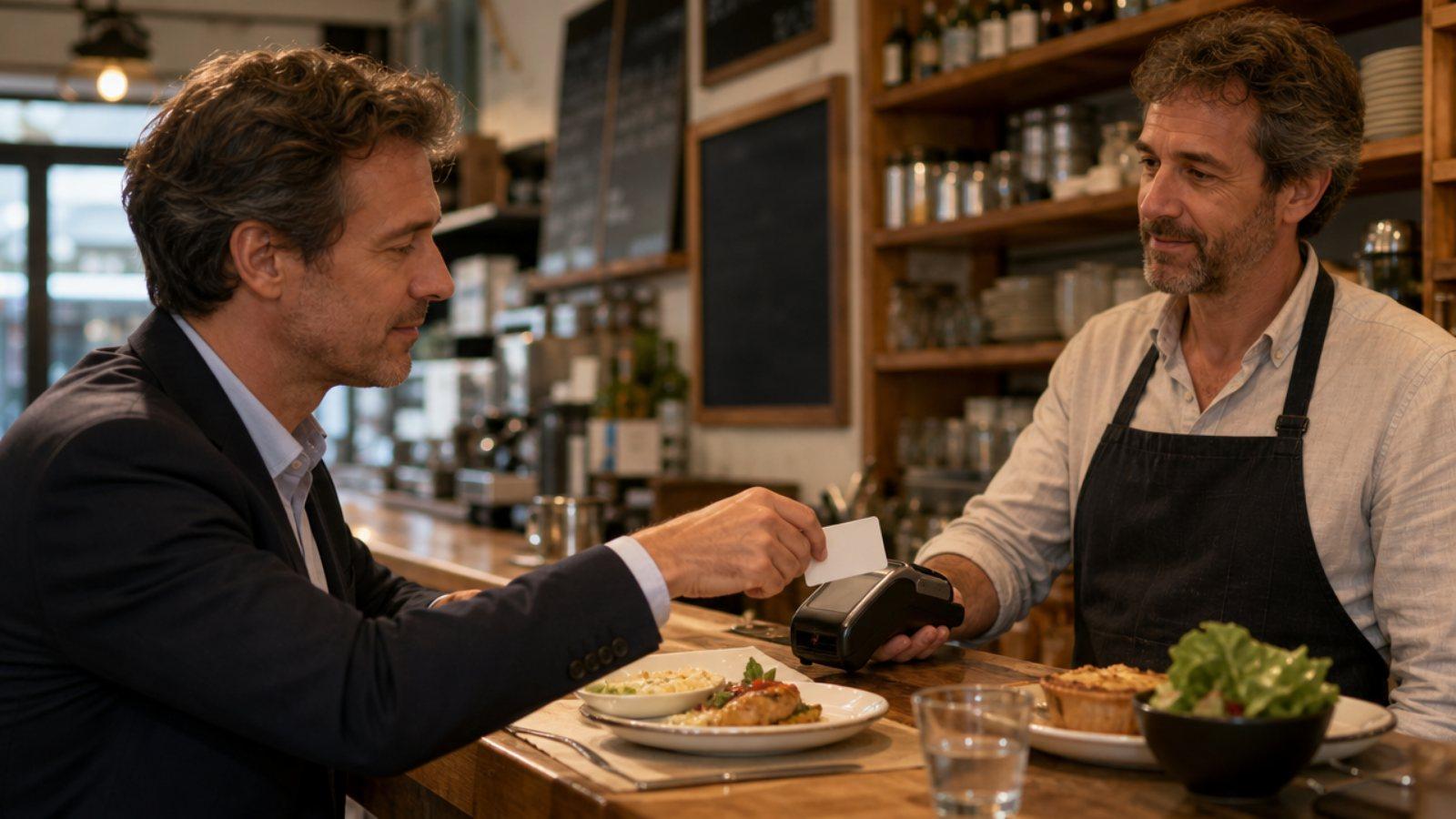
2. Paper would disappear in 2028. If you still accept paper vouchers, you will need to be able to take each issuer's cards and apps. Check now that your payment terminal or till accepts them, and at what cost. The end of paper is also the end of vouchers to sort, count and send off for reimbursement.
3. Competition from supermarkets would become permanent. If the text is adopted as it stands, employees will be able to keep spending their vouchers on groceries rather than at restaurants. Without a double cap, nothing changes compared with today; with one, part of the vouchers would in effect be reserved for meals.
What hasn't been voted yet
As of today, nothing is final:
- the text can still be amended in the chamber on 12 October, notably on the cap;
- it must then be examined by the Senate, then be the subject of an agreement between the two chambers;
- some details (excluded products, Sunday use) depend on decrees.
If no text is adopted by the end of the year, the extended use for groceries will end on 31 December 2026, and meal vouchers will only be able to pay for meals and ready-to-eat products.
We will update this article after the vote on 12 October.