A card guarantee is a card registered but not charged. The guest pays nothing. You only charge if they don't come.
It is the answer to no-shows, and it is often better accepted than a deposit: the guest doesn't spend any money.
Stripe must be connected.
Asking for it automatically, for private events
In the room's settings, choose the Card guarantee option and the maximum amount you will be able to charge, as a flat fee or per guest, and from how many guests. It is then requested for every private event in that room. It excludes the deposit.
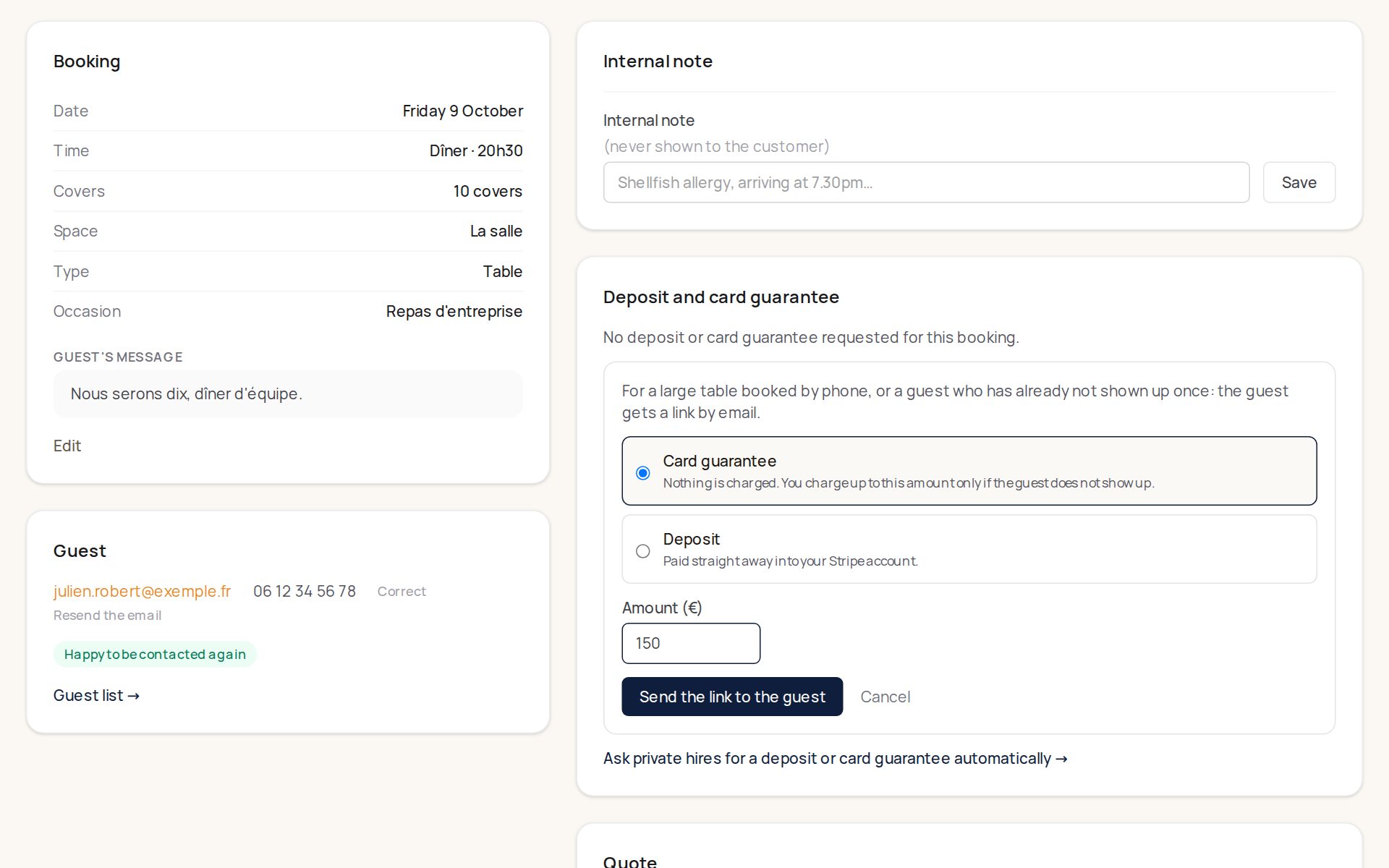
Asking for it by hand, on any booking
A large table booked by phone, a guest who has already failed to show once: open the booking's record, "Deposit and card guarantee" part, then "Ask for a deposit or a card guarantee". Choose Card guarantee, the maximum amount, and the guest receives the link by email. The booking keeps its status.
Klarr never does it automatically on an ordinary table: asking for a card for two covers drives away more guests than it prevents no-shows. You decide, booking by booking.
How it works
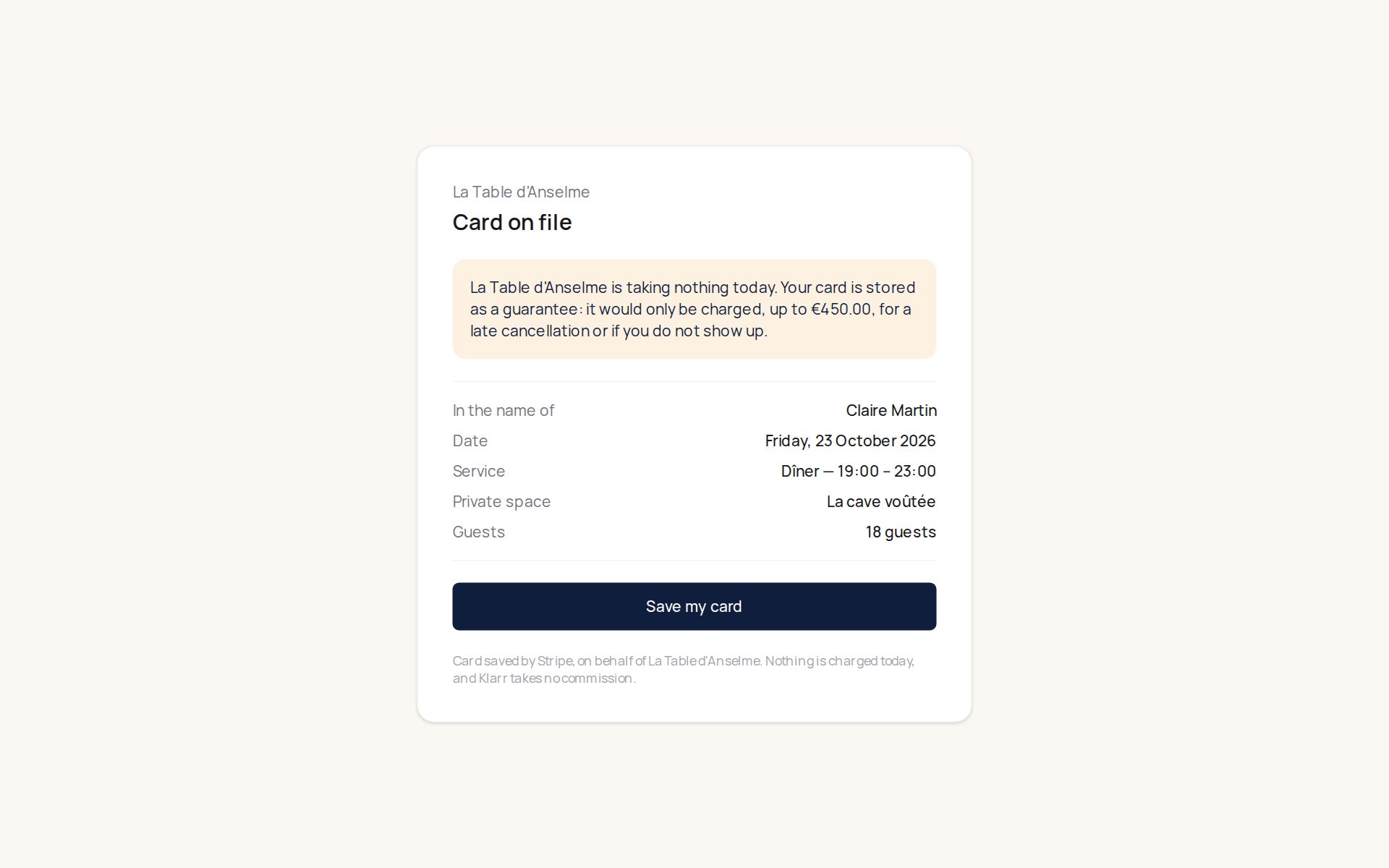
The guest registers their card via a link, on a Stripe page. Nothing is charged — neither blocked on their account nor held. It is an authorisation to charge later.
It holds over time, even several months. That is the difference with a classic bank hold, which expires after a few days and doesn't protect a private event booked in advance.
Charging
On the booking, a button lets you charge up to the ceiling you set. You can charge less: a group of twelve that comes with eight doesn't always justify the full amount.
Klarr asks you to confirm, then shows what was charged.
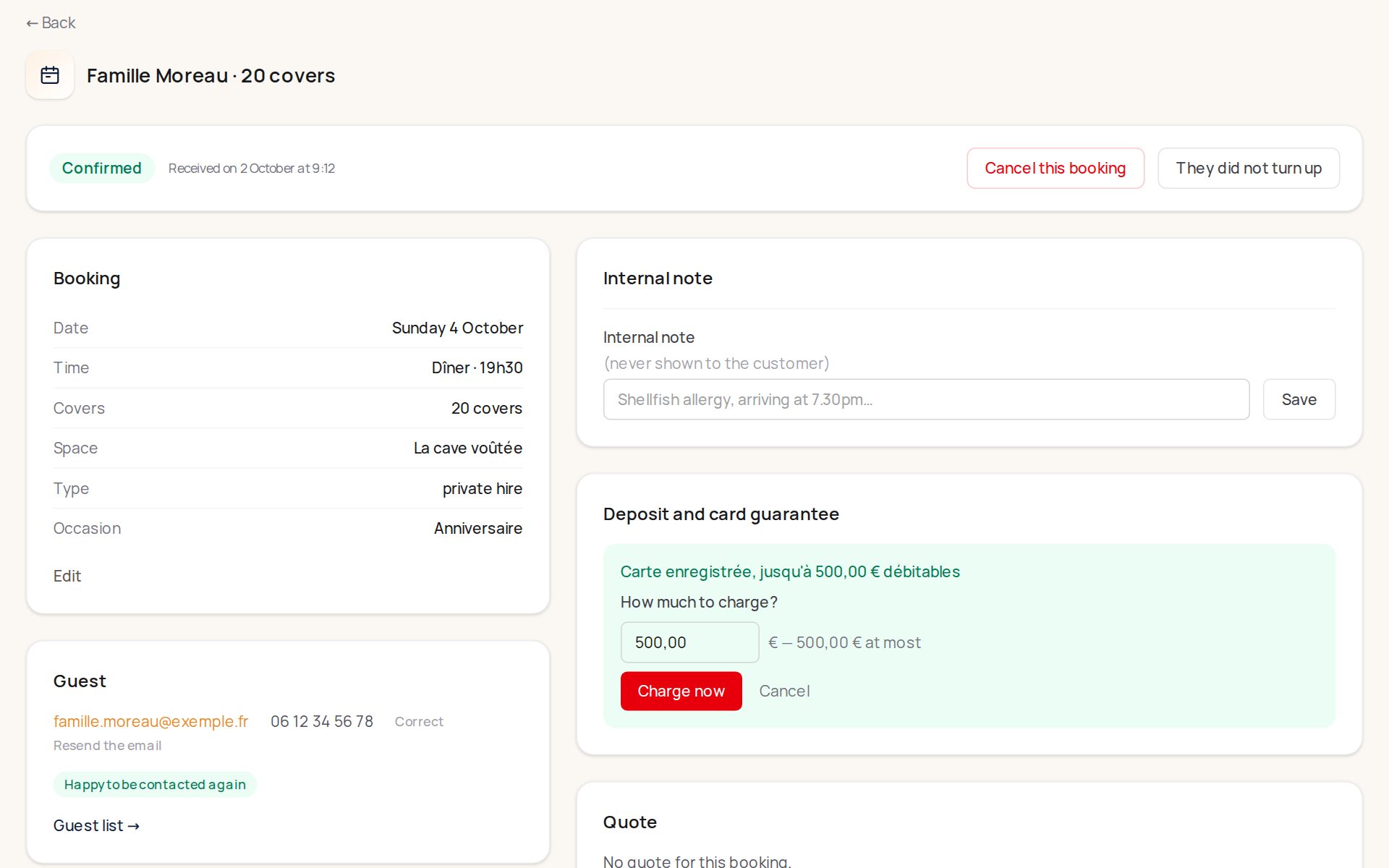
A booking that carries a guarantee stays visible until the day of the service, even once handled. So you always see what you charged, and to whom.
What the guest accepts
When registering their card, they clearly see the maximum amount and in which case it can be charged. No small print: a guarantee that surprises ends in a bank dispute, and you lose anyway.
If the charge fails
A card can refuse a deferred charge, notably if the bank asks for an authentication the guest isn't there to give. Klarr tells you. In that case, the card guarantee is not a banker's cheque: it discourages much more than it guarantees.